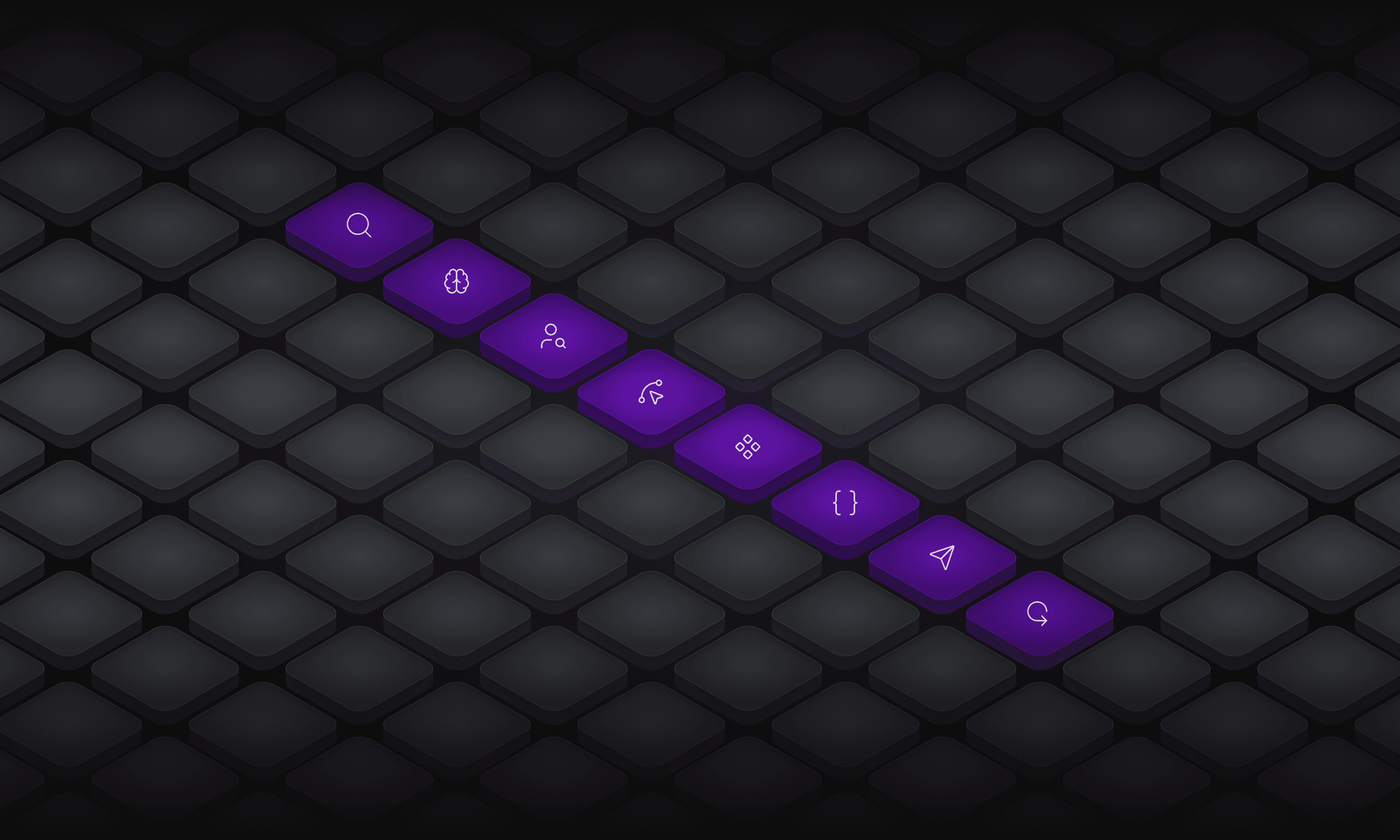
Designing with AI
AI is one part of my product design practice, used where it improves speed, range or evidence without replacing judgment.
01
01
01
01
Research & Problem Understanding
From raw data to structured insight, before a single screen exists.
The risk in complex products is framing the wrong problem. Research without structure creates noise, not clarity. I use AI to synthesise interview transcripts, parse competitor products, and extract patterns across large datasets, transforming weeks of discovery into a structured problem brief in days.
Research & Problem Understanding
From raw data to structured insight, before a single screen exists.
The risk in complex products is framing the wrong problem. Research without structure creates noise, not clarity. I use AI to synthesise interview transcripts, parse competitor products, and extract patterns across large datasets, transforming weeks of discovery into a structured problem brief in days.
I use Claude to synthesise interview transcripts, cluster themes, and extract actionable insights from raw research data. What used to take two days of manual analysis now takes a focused two-hour session.
I structure all research findings in Notion, from competitor audits to interview summaries. AI-assisted tagging and linking keeps every insight connected to the design decisions it informed.
I structure all research findings in Notion, from competitor audits to interview summaries. AI-assisted tagging and linking keeps every insight connected to the design decisions it informed.
Every user interview is automatically transcribed via Otter.ai. The transcript goes straight into Claude for synthesis, eliminating manual note-taking and keeping me focused on listening during the session.
Every user interview is automatically transcribed via Otter.ai. The transcript goes straight into Claude for synthesis, eliminating manual note-taking and keeping me focused on listening during the session.
In practice
Mapped and clustered 25+ competitor products across 4 categories in 3 days, surfacing UX patterns nobody in the confidential AI space had applied yet.
In practice
Mapped and clustered 25+ competitor products across 4 categories in 3 days, surfacing UX patterns nobody in the confidential AI space had applied yet.
02
02
02
02
Synthesis & Strategic Framing
Turning insight into product direction, without losing the nuance.
The gap between research findings and a clear product direction is where most projects lose momentum. I use AI to pressure-test assumptions, stress-test positioning, and synthesise competing priorities into a single design principle before any screen exists.
Synthesis & Strategic Framing
Turning insight into product direction, without losing the nuance.
The gap between research findings and a clear product direction is where most projects lose momentum. I use AI to pressure-test assumptions, stress-test positioning, and synthesise competing priorities into a single design principle before any screen exists.
I feed raw research findings into Claude to identify contradictions, surface blind spots, and generate a structured problem framing. The output is a single design principle that aligns the team before ideation starts.
I feed raw research findings into Claude to identify contradictions, surface blind spots, and generate a structured problem framing. The output is a single design principle that aligns the team before ideation starts.
I use Perplexity to go deep on specific domains quickly, from regulatory constraints to emerging interaction patterns. It gives me the context I need to make informed strategic decisions without spending days on secondary research.
Reduced stakeholder alignment cycles by framing the entire product around one principle before any design started: infrastructure complexity stays invisible, trust signals stay visible.
In practice
Reduced stakeholder alignment cycles by framing the entire product around one principle before any design started: infrastructure complexity stays invisible, trust signals stay visible.
In practice
03
03
03
03
Exploration & Ideation
Exhausting the solution space before committing to one direction.
The best design decisions come from exploring broadly before converging. I use AI to push ideation beyond the obvious references, find patterns from adjacent industries, and stress-test concepts before committing a single hour to execution.
Exploration & Ideation
Exhausting the solution space before committing to one direction.
The best design decisions come from exploring broadly before converging. I use AI to push ideation beyond the obvious references, find patterns from adjacent industries, and stress-test concepts before committing a single hour to execution.
I use Claude to generate divergent directions from a single brief, challenge assumptions in early concepts, and identify edge cases before they become design problems. It's a thinking partner that never defaults to the obvious answer.
I use Perplexity to research outside the expected category. The best insight for an AI product often comes from a fintech pattern, a healthcare flow, or a gaming mechanic. Perplexity gets me there fast.
I use Perplexity to research outside the expected category. The best insight for an AI product often comes from a fintech pattern, a healthcare flow, or a gaming mechanic. Perplexity gets me there fast.

I use Midjourney to explore visual directions and moodboards before opening Figma. Generating 20 visual concepts in an hour beats spending a day on a direction that turns out to be wrong.
I use Midjourney to explore visual directions and moodboards before opening Figma. Generating 20 visual concepts in an hour beats spending a day on a direction that turns out to be wrong.
In practice
Found the AI Pals concept by benchmarking consumer psychology apps, not AI products. The best insight came from outside the obvious category.
In practice
Found the AI Pals concept by benchmarking consumer psychology apps, not AI products. The best insight came from outside the obvious category.
04
04
04
04
Vibe Coding & Rapid Prototyping
From concept to testable interaction, without waiting for engineering.
I don't pick one tool and stick to it. Each prototyping tool has a different strength, and I choose based on what the project needs: speed, fidelity, testability, or code quality. Sometimes I run all of them in parallel just to see which direction lands better.
Vibe Coding & Rapid Prototyping
From concept to testable interaction, without waiting for engineering.
I don't pick one tool and stick to it. Each prototyping tool has a different strength, and I choose based on what the project needs: speed, fidelity, testability, or code quality. Sometimes I run all of them in parallel just to see which direction lands better.

When I need a fully functional prototype fast, Lovable generates a working React app from a prompt. I use it to test full flows with real interactions before touching Figma. What I can click through reveals problems that static mocks never surface.
When the prototype needs to be closer to production, I switch to Cursor. It lets me write and edit code with AI assistance, giving me more control over the output while staying fast. Best for flows that will eventually hand off to engineering.
When the prototype needs to be closer to production, I switch to Cursor. It lets me write and edit code with AI assistance, giving me more control over the output while staying fast. Best for flows that will eventually hand off to engineering.
When I want to stay inside Figma and explore UI directions quickly, Figr generates components and layouts I can react to immediately. It's my go-to for visual exploration before committing to a design direction.
When I want to stay inside Figma and explore UI directions quickly, Figr generates components and layouts I can react to immediately. It's my go-to for visual exploration before committing to a design direction.

When I need an interactive prototype that lives natively in Figma, Figma Make generates it directly on the canvas. I use it when the deliverable is a prototype for stakeholder review rather than a dev handoff.
When I need an interactive prototype that lives natively in Figma, Figma Make generates it directly on the canvas. I use it when the deliverable is a prototype for stakeholder review rather than a dev handoff.
Prototyped the full PrivatAI conversational flow in code before a single Figma frame, catching major interaction issues that wouldn't have surfaced in static mocks.
In practice
Prototyped the full PrivatAI conversational flow in code before a single Figma frame, catching major interaction issues that wouldn't have surfaced in static mocks.
In practice
05
05
05
05
Design System & Scalable Foundations
Building the system that makes every future decision faster.
A design system is only valuable if it stays consistent while the product evolves. I use AI to build, document, and maintain design systems in parallel with shipping product, so the system never falls behind the work it's supposed to govern.
Design System & Scalable Foundations
Building the system that makes every future decision faster.
A design system is only valuable if it stays consistent while the product evolves. I use AI to build, document, and maintain design systems in parallel with shipping product, so the system never falls behind the work it's supposed to govern.
I use Claude to generate component documentation, write usage guidelines, and maintain consistency rules across the system. Every new component gets documented as it's built, not retroactively.
I use Claude to generate component documentation, write usage guidelines, and maintain consistency rules across the system. Every new component gets documented as it's built, not retroactively.
Figma is where the system lives. I structure it around atomic principles, with variables, auto-layout, and component properties that make every new screen a composition of existing decisions rather than a new one.
Figma is where the system lives. I structure it around atomic principles, with variables, auto-layout, and component properties that make every new screen a composition of existing decisions rather than a new one.
I use Figr to generate and extend components directly inside Figma, already aligned with the existing design system tokens and variables. New components start consistent by default, reducing review cycles and keeping the system tight as the product scales.
In practice
One designer. Five product surfaces. Zero inconsistency, because the system was built before the product, not after.
In practice
One designer. Five product surfaces. Zero inconsistency, because the system was built before the product, not after.
06
06
06
06
Ship & Iterate
Closing the loop between shipped product and real behaviour.
Shipping is not the end of the design cycle. The most valuable design decisions come from what users actually do after launch. I use AI to surface friction patterns faster, prioritise fixes with precision, and keep iteration cycles tight without losing sight of the bigger product direction.
Ship & Iterate
Closing the loop between shipped product and real behaviour.
Shipping is not the end of the design cycle. The most valuable design decisions come from what users actually do after launch. I use AI to surface friction patterns faster, prioritise fixes with precision, and keep iteration cycles tight without losing sight of the bigger product direction.
I use Claude to analyse qualitative feedback at scale, from support tickets to community messages, identifying recurring friction patterns and translating them into prioritised design improvements.
I use Claude to analyse qualitative feedback at scale, from support tickets to community messages, identifying recurring friction patterns and translating them into prioritised design improvements.
Session recordings and heatmaps tell me where users hesitate, drop off, or misread the interface. I feed those observations into Claude to cross-reference with qualitative findings and build a complete picture of what needs fixing first.
I track key funnel metrics and feature adoption rates in Mixpanel. When a number moves unexpectedly, I use it as the starting point for a focused design investigation rather than a reactive redesign.
I track key funnel metrics and feature adoption rates in Mixpanel. When a number moves unexpectedly, I use it as the starting point for a focused design investigation rather than a reactive redesign.
Established a weekly design iteration cycle during MVP phase, using AI to surface friction patterns and prioritise fixes before mainnet launch.
In practice
Established a weekly design iteration cycle during MVP phase, using AI to surface friction patterns and prioritise fixes before mainnet launch.
In practice
Articles
I also write about it.
From practice, not from observation.
I also write about it.
From practice, not from observation.
Every article here comes from a design decision I had to make in production. Not a case study, not a thought experiment. A real product, real users, real constraints. The more I design for AI, the more I realize how much of this territory is still unmapped.
Every article here comes from a design decision I had to make in production. Not a case study, not a thought experiment. A real product, real users, real constraints. The more I design for AI, the more I realize how much of this territory is still unmapped.
These articles are my attempt to map it.
These articles are my attempt to map it.
2025
Systems
Trust
Most AI products fail at the translation layer
Most AI products fail at the same point. Not technically. The model works. But somewhere between what the system does and what the user understands, something breaks. That gap has a name.
5 min read
2025
Interfaces
Behavior
Designing AI is not designing screens
Most designers working on AI products are doing the same job they've always done. Mapping flows. Building components. Designing states. That work still matters. It's just not enough anymore.
5 min read
2025
Behavior
Trust
The UX of uncertainty
Uncertainty in an AI system is not an edge case. It's the baseline condition of every output the system produces. The question is never whether it exists. It's whether the design acknowledges it.
5 min read
2025
Interfaces
Sustems
The best AI interface is the one users forget exists
Invisible doesn't mean minimal. It means absent from the user's conscious attention. In AI products, earning that invisibility is harder than it has ever been. And more important.
5 min read
2025
Agency
Trust
Designing the handoff between human and AI
The most critical moment in an AI product is not when the user interacts with the system. It's when control changes hands. That moment is almost universally badly designed.
5 min read
2026
Context
Behavior
Context is the new content
In traditional products, content exists before the user arrives. In AI products, what the user sees depends on who they are and what they've done before. That changes everything about how design works.
5 min read
2026
Onboarding
Context
What onboarding looks like when the product learns
Classical onboarding teaches the user how to use the product. AI product onboarding has to do something harder: begin the process of the product learning the user. Most teams design only one side of this.
5 min read
2026
Trust
Strategy
Trust is not a UX pattern. It's an architecture decision.
Every design team working on an AI product has had the same conversation. The product feels untrustworthy. The solution proposed is always surface work. It's almost never the real problem.
5 min read
2026
Behavior
Agency
Designing for the second decision
Most design work is obsessed with the first interaction. In AI products, the decision that determines whether a user stays or leaves almost never happens first. It happens second.
5 min read

2026
Systems
Strategy
Why the best AI products have the least visible AI
The AI products people actually integrate into how they work have something in common. The AI in them is almost invisible. This is not a coincidence. It's a design consequence.
5 min read
2025
Systems
Trust
Most AI products fail at the translation layer
Most AI products fail at the same point. Not technically. The model works. But somewhere between what the system does and what the user understands, something breaks. That gap has a name.
5 min read
2025
Interfaces
Behavior
Designing AI is not designing screens
Most designers working on AI products are doing the same job they've always done. Mapping flows. Building components. Designing states. That work still matters. It's just not enough anymore.
5 min read
2025
Behavior
Trust
The UX of uncertainty
Uncertainty in an AI system is not an edge case. It's the baseline condition of every output the system produces. The question is never whether it exists. It's whether the design acknowledges it.
5 min read
2025
Interfaces
Sustems
The best AI interface is the one users forget exists
Invisible doesn't mean minimal. It means absent from the user's conscious attention. In AI products, earning that invisibility is harder than it has ever been. And more important.
5 min read
2025
Agency
Trust
Designing the handoff between human and AI
The most critical moment in an AI product is not when the user interacts with the system. It's when control changes hands. That moment is almost universally badly designed.
5 min read
2026
Context
Behavior
Context is the new content
In traditional products, content exists before the user arrives. In AI products, what the user sees depends on who they are and what they've done before. That changes everything about how design works.
5 min read
2026
Onboarding
Context
What onboarding looks like when the product learns
Classical onboarding teaches the user how to use the product. AI product onboarding has to do something harder: begin the process of the product learning the user. Most teams design only one side of this.
5 min read
2026
Trust
Strategy
Trust is not a UX pattern. It's an architecture decision.
Every design team working on an AI product has had the same conversation. The product feels untrustworthy. The solution proposed is always surface work. It's almost never the real problem.
5 min read
2026
Behavior
Agency
Designing for the second decision
Most design work is obsessed with the first interaction. In AI products, the decision that determines whether a user stays or leaves almost never happens first. It happens second.
5 min read
2026
Systems
Strategy
Why the best AI products have the least visible AI
The AI products people actually integrate into how they work have something in common. The AI in them is almost invisible. This is not a coincidence. It's a design consequence.
5 min read
2025
Systems
Trust
Most AI products fail at the translation layer
Most AI products fail at the same point. Not technically. The model works. But somewhere between what the system does and what the user understands, something breaks. That gap has a name.
5 min read
2025
Interfaces
Behavior
Designing AI is not designing screens
Most designers working on AI products are doing the same job they've always done. Mapping flows. Building components. Designing states. That work still matters. It's just not enough anymore.
5 min read
2025
Behavior
Trust
The UX of uncertainty
Uncertainty in an AI system is not an edge case. It's the baseline condition of every output the system produces. The question is never whether it exists. It's whether the design acknowledges it.
5 min read
2025
Interfaces
Sustems
The best AI interface is the one users forget exists
Invisible doesn't mean minimal. It means absent from the user's conscious attention. In AI products, earning that invisibility is harder than it has ever been. And more important.
5 min read
2025
Agency
Trust
Designing the handoff between human and AI
The most critical moment in an AI product is not when the user interacts with the system. It's when control changes hands. That moment is almost universally badly designed.
5 min read
2026
Context
Behavior
Context is the new content
In traditional products, content exists before the user arrives. In AI products, what the user sees depends on who they are and what they've done before. That changes everything about how design works.
5 min read
2026
Onboarding
Context
What onboarding looks like when the product learns
Classical onboarding teaches the user how to use the product. AI product onboarding has to do something harder: begin the process of the product learning the user. Most teams design only one side of this.
5 min read
2026
Trust
Strategy
Trust is not a UX pattern. It's an architecture decision.
Every design team working on an AI product has had the same conversation. The product feels untrustworthy. The solution proposed is always surface work. It's almost never the real problem.
5 min read
2026
Behavior
Agency
Designing for the second decision
Most design work is obsessed with the first interaction. In AI products, the decision that determines whether a user stays or leaves almost never happens first. It happens second.
5 min read
2026
Systems
Strategy
Why the best AI products have the least visible AI
The AI products people actually integrate into how they work have something in common. The AI in them is almost invisible. This is not a coincidence. It's a design consequence.
5 min read
Continuous Learning
Building expertise at the intersection of
AI and design.
Building expertise at the intersection of
AI and design.
Certifications to understand the systems I design for, not just the surfaces.
Certifications to understand the systems I design for, not just the surfaces.

Completed
AI For Everyone
Non-technical introduction to AI: what it can and can't do, how AI projects are built, and how to think about AI strategy at an organizational level. The starting point before going deeper.

Completed
Google AI Professional Certificate
Practical AI fluency across 7 courses, using real tools to solve real work problems across research, writing, and product delivery.
Completed
Introduction to Artificial Intelligence
Foundations of AI: machine learning, neural networks, generative AI, and LLMs. Understanding the systems before using them.

In Progress
Vibe Coding with Cursor AI
Hands-on training in AI-assisted development with Cursor: chat panel, agent mode, and context-aware tools for building, debugging, and iterating on real applications.
In Progress
Agent Skills with Anthropic
Hands-on training in building AI agents with Claude: tool use, multi-step reasoning, and how agentic systems make decisions without human input at every step.

In progress
Generative AI Engineering with LLMs Specialization
7-course specialization covering how LLMs are built, trained, and deployed. From tokenization and transformer architectures to fine-tuning, RAG, and LangChain, with a capstone project building a production-ready question-answering system.
Completed
AI For Everyone
Non-technical introduction to AI: what it can and can't do, how AI projects are built, and how to think about AI strategy at an organizational level. The starting point before going deeper.
Completed
Google AI Professional Certificate
Practical AI fluency across 7 courses, using real tools to solve real work problems across research, writing, and product delivery.
Completed
Introduction to Artificial Intelligence
Foundations of AI: machine learning, neural networks, generative AI, and LLMs. Understanding the systems before using them.
In Progress
Vibe Coding with Cursor AI
Hands-on training in AI-assisted development with Cursor: chat panel, agent mode, and context-aware tools for building, debugging, and iterating on real applications.
In Progress
Agent Skills with Anthropic
Hands-on training in building AI agents with Claude: tool use, multi-step reasoning, and how agentic systems make decisions without human input at every step.
In progress
Generative AI Engineering with LLMs Specialization
7-course specialization covering how LLMs are built, trained, and deployed. From tokenization and transformer architectures to fine-tuning, RAG, and LangChain, with a capstone project building a production-ready question-answering system.
Completed
AI For Everyone
Non-technical introduction to AI: what it can and can't do, how AI projects are built, and how to think about AI strategy at an organizational level. The starting point before going deeper.
Completed
Google AI Professional Certificate
Practical AI fluency across 7 courses, using real tools to solve real work problems across research, writing, and product delivery.
Completed
Introduction to Artificial Intelligence
Foundations of AI: machine learning, neural networks, generative AI, and LLMs. Understanding the systems before using them.
In Progress
Vibe Coding with Cursor AI
Hands-on training in AI-assisted development with Cursor: chat panel, agent mode, and context-aware tools for building, debugging, and iterating on real applications.
In Progress
Agent Skills with Anthropic
Hands-on training in building AI agents with Claude: tool use, multi-step reasoning, and how agentic systems make decisions without human input at every step.
In progress
Generative AI Engineering with LLMs Specialization
7-course specialization covering how LLMs are built, trained, and deployed. From tokenization and transformer architectures to fine-tuning, RAG, and LangChain, with a capstone project building a production-ready question-answering system.
Raphaël.D
Senior Product Designer
© 2026 Raphaël.D. All rights reserved.
Made from scratch in Framer with 💜
Raphaël.D
Senior Product Designer
© 2026 Raphaël.D. All rights reserved.
Made from scratch in Framer with 💜
Raphaël.D
Senior Product Designer
© 2026 Raphaël.D. All rights reserved.
Made from scratch in Framer with 💜
Designing with AI
AI is one part of my product design practice, used where it improves speed, range or evidence without replacing judgment.
Designing with AI
AI is one part of my product design practice, used where it improves speed, range or evidence without replacing judgment.